
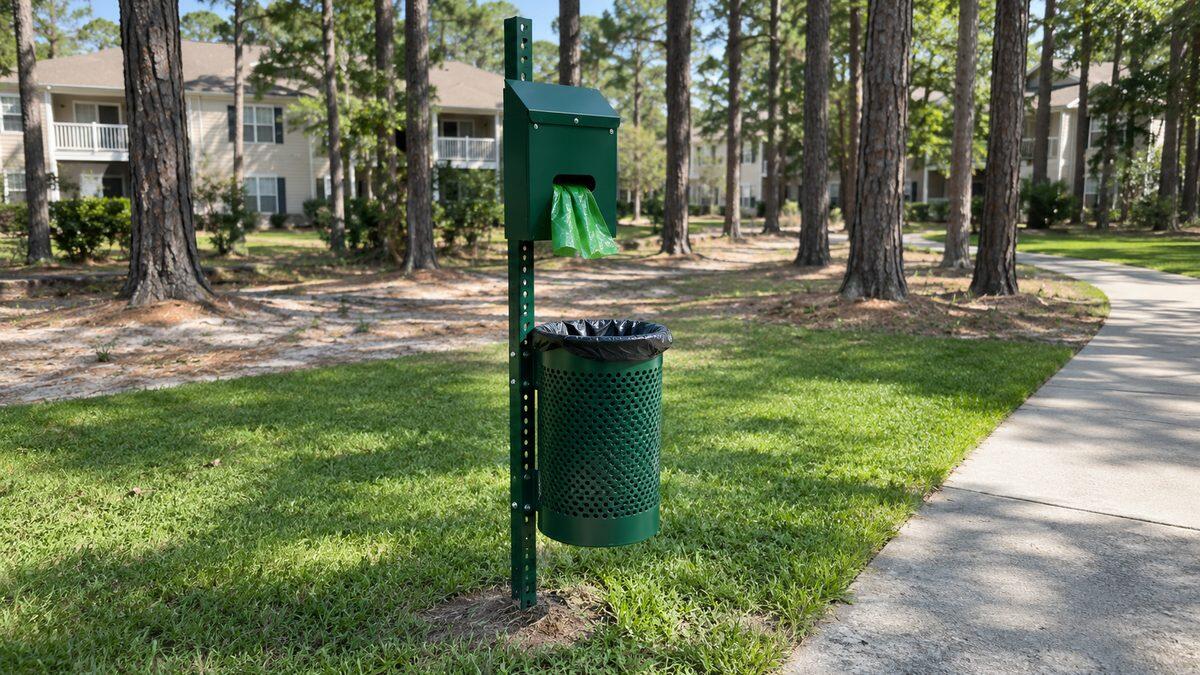
Ask any leasing office what residents complain about and pet waste makes the short list every time, usually ahead of noise and right next to parking. The complaint is never really about dogs. It is about the four or five owners who do not pick up, the shoes of everyone who finds out, and a lawn that tells every prospective renter on the tour exactly how the property is managed.
Pet waste stations are the standard fix, and they genuinely work, but only for a specific reason that most properties never hear explained: stations do not improve residents, they shorten the distance between good intentions and a trash can. This guide covers that mechanism, the placement patterns that fit apartment layouts, the single failure mode that quietly kills most station programs, and the policy pairing that handles the residents a station cannot. It ends with what a station program can and cannot promise a property manager.
The Short Answer
Pet waste stations reduce complaints by removing the two excuses behind most violations: no bag and no bin. Stations placed along walking routes and near building exits raise pickup compliance, but only when dispensers stay stocked and receptacles get emptied, which makes the maintenance schedule, not the hardware, the real product.
Why Waste Tops the Complaint Log
Industry surveys of pet-friendly properties keep finding the same thing: the top pet complaints are about owners, not animals. Waste is the worst of them because it is cumulative and public. A barking dog annoys a neighbor; an unscooped lawn annoys every resident who crosses it, twice a day, and it photographs badly in every review and tour. It is also self-reinforcing. Once a lawn visibly tolerates waste, compliant owners start wondering why they bother, and the problem recruits.
How Stations Change Behavior
Nearly every violation starts with one of two sentences: “I did not have a bag” or “there was nowhere to put it.” Both are distance problems, and stations are distance solutions. When a dispenser sits on the route a resident already walks, and a lidded receptacle sits next to it, picking up becomes the path of least resistance instead of a planning exercise. That is the entire mechanism. A station does not shame anyone into virtue; it makes virtue take eleven seconds. Properties that grasp this stop buying one impressive station for the leasing office lawn and start buying coverage for the actual walking routes.
The Failure Mode That Kills Station Programs
An empty dispenser is worse than no station at all. It tells residents the property made a promise and stopped keeping it, and it hands every violator a documented excuse. The same goes for an overflowing receptacle, which converts the cleanest corner of the lawn into its worst. Most failed station programs die exactly this way: installed with a press release, restocked with good intentions, and abandoned by month three when nobody owns the schedule. Before a property buys hardware, it should decide who refills it, who empties it, on what cadence, and what happens in August when both jobs double.
Placement for Apartment Layouts
- Building exits. The first thirty feet of every dog walk. A station here catches the morning rush.
- The walking loop. Most properties have one de facto circuit; space stations along it so no point on the loop is more than a short detour from a bag.
- Designated relief areas. If the property has a dog run or pet area, it needs its own station, serviced more often than the rest.
- Transition zones. Where paths meet parking lots or dumpster corrals, residents will use a station they pass anyway.
Keep every station visible from the path, lit by existing fixtures, and reachable without crossing mud. A common spacing rule puts a station roughly every 150 yards along walked routes; layout matters more than the exact number, and a walkthrough with a leash map beats any formula.
Pair the Hardware With Policy
Stations convert the willing. The lease converts the rest. The combination that works is unglamorous: a pickup clause in the pet addendum, a friendly mention in the move-in packet, signage that reads like a neighbor rather than a citation, and consistent follow-through on the few residents who still decline. Properties that skip the policy half end up asking hardware to do enforcement, which it cannot. Properties that skip the hardware half end up enforcing a rule they made inconvenient to follow, which reads as unfair because it is.
What a Service Takes Off Your Plate
A station route is small, recurring, physical work: bag replenishment, receptacle emptying, cleanup around each unit, inspections with condition notes, and records that prove it happened. Some properties fold it into maintenance duties and do fine until turnover or summer volume breaks the habit. Others hand it to a route service so the schedule survives staffing. Ours bundles station service with common-area sweeps for exactly that reason; the station program details and the commercial quote process are both public. Either way, the deciding question is the one from the failure-mode section: who owns the schedule?
Common Questions From Property Managers
How many stations does an apartment community need?
Enough that no walked route leaves a resident more than a short detour from a bag. Smaller garden-style properties usually land between two and four; larger ones add a station per loop or courtyard cluster.
How often do stations need service?
Weekly as a floor, twice weekly in summer or at high-traffic relief areas. The dispenser should never hit empty and the receptacle should never hit the lid.
Will stations eliminate waste complaints?
They eliminate the majority that comes from inconvenience. A small core of determined non-scoopers remains at every property, and that is a lease-enforcement problem with a short, nameable list once the lawn stops providing cover.
Who should pay for the program?
Properties typically fund it as grounds maintenance, the same budget line as landscaping. Some recover it through pet rent or fees already charged; either way it costs less than the vacancy risk of a lawn that advertises neglect.
The Bottom Line
A station program is behavioral infrastructure. It works because most residents were always willing to pick up and simply needed the supplies within reach of the walk they already take. Place stations where the leashes travel, keep the dispensers stocked with the discipline of a pool-chemical log, write the expectation into the lease, and the complaint thread thins out within a season. Skip the maintenance and the same hardware becomes a monument to the day the property stopped trying.
The bottom line is this: stations plus upkeep plus a clear policy converts the persuadable majority, which is most of the problem, and turns the rest into a short, documented enforcement list instead of an anonymous lawn-wide grievance. For a pet-friendly property competing for renters who tour with a dog in the car, that trade, a modest monthly route against the loudest line in the complaint log, is about as close to easy math as property management gets.
Want the Station Route Handled?
Walkthrough, placement plan, and a written scope your regional can approve.